
Body & hair 미백 수액
Skin Whitening IV in Hongdae, Seoul – Beautystone Clinic
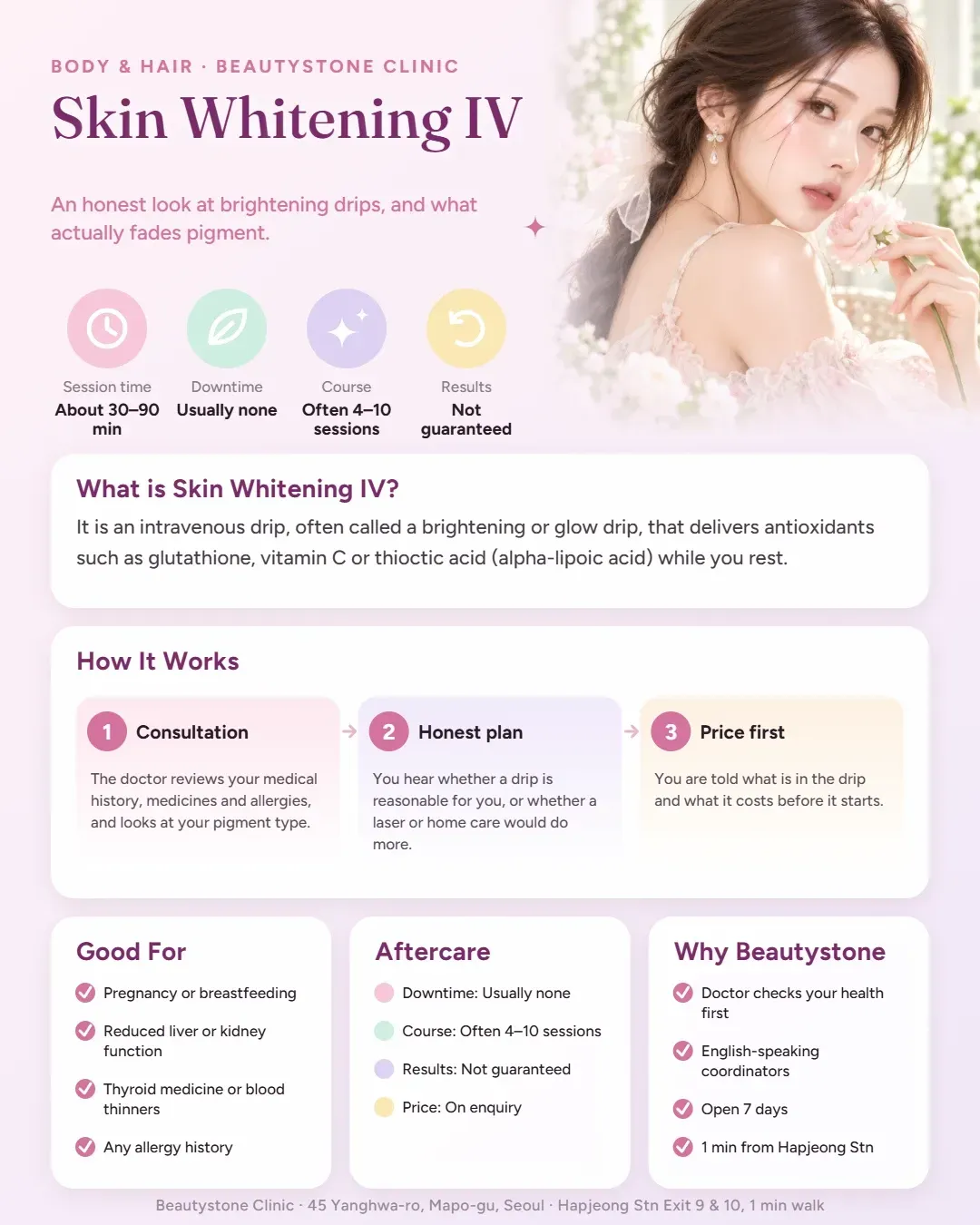
An honest look at brightening drips, and what actually fades pigment.
Skin whitening or brightening IVs are drips that usually contain glutathione, vitamin C or thioctic acid. At Beautystone Clinic in Hapjeong, next to Hongdae, a doctor first checks your health and the type of pigment you have, explains what a drip can and cannot do, and tells you when a laser or home care will help your tone more directly.

- Session time
- About 30–90 min depends on the drip
- Downtime
- Usually none small bruise possible
- Course
- Often 4–10 sessions a single drip is not a lasting fix
- Results
- Not guaranteed vary widely; fade after stopping
- Price
- On enquiry ask us on WhatsApp

01
What is a skin whitening IV?
Short answer: It is an intravenous drip, often called a brightening or glow drip, that delivers antioxidants such as glutathione, vitamin C or thioctic acid (alpha-lipoic acid) while you rest.
In Korea these drips are known by nicknames: 백옥 (baekok) for glutathione and 신데렐라 (Cinderella) for thioctic acid, often given with high-dose vitamin C. Glutathione is the ingredient most linked to skin tone; vitamin C and thioctic acid are mainly there as supporting antioxidants that help reduce oxidative stress.
At Beautystone the content of the drip is set by the doctor after a consultation, not chosen from a menu.
02
Does a whitening IV really lighten skin?
Short answer: Sometimes a little, and not for everyone. Research shows glutathione can shift some melanin production toward lighter pigment, but the change is modest, appears only in some people, and tends to fade once you stop.
Glutathione does not remove pigment that is already there. It is thought to tilt melanin production from dark eumelanin toward lighter pheomelanin. In published studies, the drop in melanin was meaningful only in some body sites and age groups, and in one study only about 37.5% of participants noticed a change, which disappeared within 6 months.
Dermatology guidelines for melasma start with sun protection, topical treatment and, where appropriate, prescribed medicine such as tranexamic acid. IV glutathione is not a standard melasma treatment . That is why we treat a whitening drip as an optional extra, never as the main plan for spots.
03
Whitening IV vs laser for dark spots and uneven tone
Short answer: For freckles, sun spots or melasma, lasers and good sun protection act on the pigment directly. A drip can be combined with them, but should not be expected to clear spots.
| Whitening IV | Pigment laser | Sun protection & home care | |
|---|---|---|---|
| How it works | Antioxidants given through a vein | Light energy targets pigment in the skin | Prevents new pigment from forming |
| Best for | Optional support for overall tone | Freckles, sun spots, melasma, dull tone | Everyone, before and after any treatment |
| Evidence | Limited and inconsistent | Established for many pigment types | Strong, the foundation of every plan |
| Downtime | Usually none | Usually little, varies by laser | None |
See pico toning, laser toning, IPL and our hyperpigmentation guide. The first step is working out what kind of pigment you have: sun-driven, hormonal or left after inflammation.
04
How does a whitening IV session work at Beautystone?
The Beautystone difference: the drip starts with a doctor who looks at your skin and your health, not with a menu.

- Consultation. The doctor reviews your medical history, medicines and allergies, and looks at your pigment type.
- Honest plan. You hear whether a drip is reasonable for you, or whether a laser or home care would do more.
- Price first. You are told what is in the drip and what it costs before it starts.
- The infusion. You rest in a private room while the drip runs, with staff checking on you.
- Aftercare. Guidance on the needle site, sun protection and whether a course makes sense.
05
How many whitening IV sessions do you need?
Short answer: One drip is not a lasting fix. When it is used, it is usually planned as a course of about 4–10 sessions at set intervals, together with sun protection and, if needed, a pigment laser.
Any change usually fades after the course ends, so the doctor discusses whether repeating it is worthwhile for you. Each session typically takes about 30 to 90 minutes, and there is usually no downtime, so you can carry on with your day in Hongdae afterwards.
06
Is a skin whitening IV safe? Who should avoid it?
Short answer: It is generally well tolerated when given after a medical check, but serious reactions such as anaphylaxis and strain on the liver have been reported with IV glutathione, and standard doses and intervals are not firmly established.
Common effects are minor, such as a small bruise or tenderness at the needle site. Tell us before treatment if any of the following apply; the doctor may suggest postponing or choosing another option:
- Pregnancy or breastfeeding
- Reduced liver or kidney function
- Thyroid medicine or blood thinners (anticoagulants)
- Any allergy history
- Palpitations, rash or breathing difficulty after a previous injection
Tell staff straight away if you feel unwell during the drip.
07
How much does a whitening IV cost in Hongdae?
Short answer: IV drips are priced on enquiry, because the content depends on what the doctor recommends. Message us on WhatsApp and a coordinator replies in English before you book.
The final price is confirmed after the consultation and before the drip starts. Prices for pigment lasers are on our price guide(VAT excluded).
08
Skin whitening IV FAQ
Will a whitening IV make my skin permanently lighter?
No. Any change from glutathione is usually modest, varies between people and tends to fade after you stop. We do not promise a lighter skin tone.
What is in a Korean whitening drip?
Usually glutathione (called 백옥, baekok), sometimes with vitamin C or thioctic acid (the 신데렐라 or Cinderella drip). The doctor decides the content after your consultation.
Can a whitening IV remove melasma or freckles?
It should not be expected to. Melasma and freckles respond better to sun protection, topical treatment and pigment lasers such as pico toning; a drip can be added as support if the doctor agrees.
How many sessions are needed?
When used, a course of about 4–10 sessions at set intervals is typical. A single drip is not a lasting fix.
How long does a session take?
Usually about 30 to 90 minutes, plus time for the consultation on your first visit.
Is it safe?
It is generally well tolerated after a medical review, but allergic reactions, including rare severe ones, and liver strain have been reported. Tell us about pregnancy, liver or kidney problems, thyroid medicine, blood thinners or allergies.
Can I combine it with a laser on the same day?
Often yes, if the doctor agrees. Combining a drip with a pigment laser and daily sunscreen is more realistic than relying on the drip alone.
✦
Your doctors at Beautystone Clinic
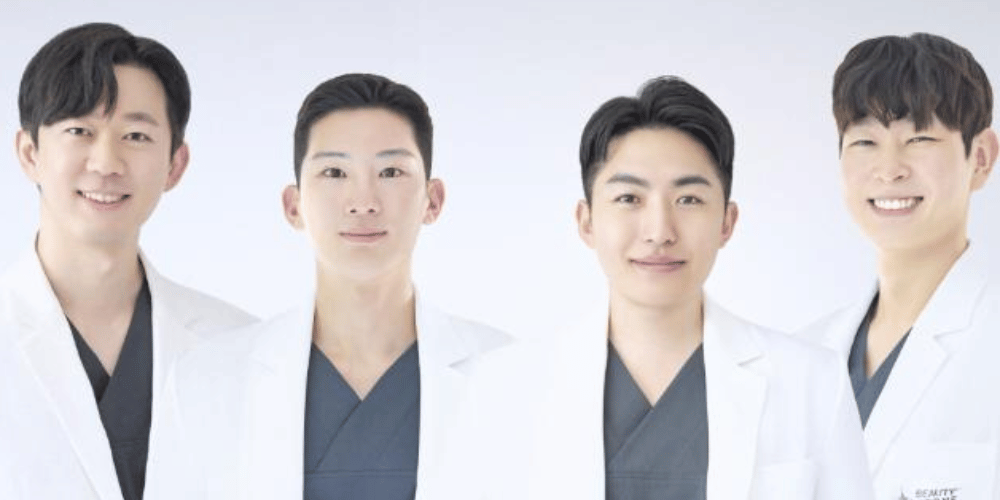
Beautystone is run by its doctors. Five chief directors consult and treat at the Hapjeong clinic, and one of them sees you before any device is chosen. Our doctors train on facial anatomy and injection safety, including the Medytox cadaver workshop in Bangkok.
Ask about brightening in Hongdae
Send us a photo of the spots or tone you want to improve and a little about your health. A coordinator replies in English with what our doctors usually suggest and what it costs.
More IV therapy 수액
Compare before you choose.
Visit us 오시는 길
45 Yanghwa-ro, Mapo-gu, Seoul
Mecenatpolis Mall, Units 133–135 & 215–218 · Hapjeong Station exits 9 & 10, about a 1-minute walk.